
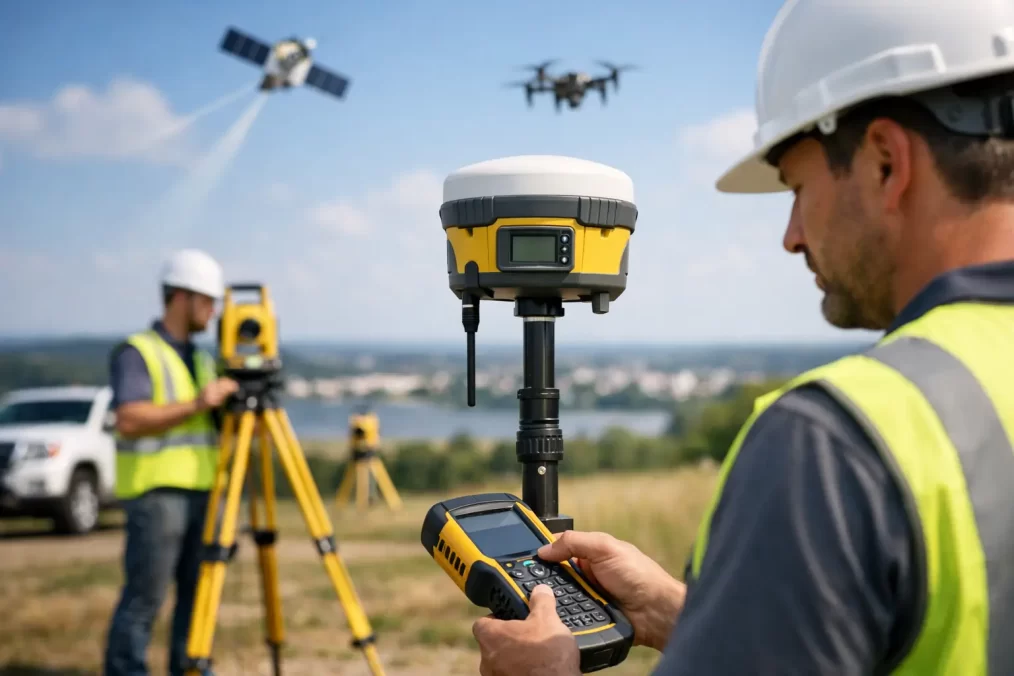
Trimble survey technology benefits explained
When a boundary mark is missing, a slab set-out needs to happen tomorrow, or a subdivision plan is holding up the next approval step, the real value of Trimble survey technology benefits becomes obvious very quickly. Better equipment does not just make surveying look more advanced. It changes how fast data can be captured, how reliably it can be checked, and how confidently the next consultant in the chain can keep moving.
For property owners, builders, architects and developers, that matters because surveying rarely sits in isolation. Survey information feeds design, council submissions, construction set-out, compliance checks and final registration. If the survey is slow, incomplete or difficult to verify, every downstream task feels it.
Why Trimble survey technology benefits matter on real projects
On paper, all survey gear is there to measure points. On an active project, the difference is much more practical. The question is whether the technology helps deliver accurate information quickly, in conditions that are rarely perfect, without creating extra rework.
Trimble systems are widely used because they support that outcome across different survey tasks. A topographical survey for an architect, a cadastral boundary mark-out for a homeowner, and a construction set-out for a builder all demand slightly different workflows. The benefit is not simply that the equipment is advanced. It is that it helps the surveyor adapt to the site, the job stage and the required level of precision.
That distinction matters. Fast data capture is useful, but not if the information is unsuitable for design. High precision is essential, but not if the process is so slow it delays mobilisation or a council submission. Good surveying technology earns its place when it balances speed, accuracy and usability.
Faster fieldwork without cutting corners
One of the clearest Trimble survey technology benefits is time efficiency in the field. Modern survey workflows can collect and process more usable information in less time than older methods, particularly across larger sites, difficult terrain or busy construction environments.
That does not mean every job becomes quick and easy. Dense vegetation, poor satellite visibility, steep land, traffic conditions and restricted access still affect field time. But quality equipment gives the surveyor more options. Depending on site conditions, they can shift between total station and GNSS workflows, maintain productivity, and avoid the stop-start delays that can happen when equipment is less capable.
For clients, the practical gain is faster turnaround. Architects can receive topographical data sooner and begin design with more confidence. Builders can get set-out completed on programme. Developers can keep momentum across multiple stages instead of waiting on one survey task to finish before the next consultant starts.
Speed also reduces site disruption. On active residential and commercial projects, less time spent occupying work areas can make coordination easier for other trades and reduce unnecessary downtime.
Accuracy that supports approvals and construction
Accuracy is the obvious selling point of survey technology, but it is worth being specific about what that means. In a property and development context, accuracy is not just about technical performance. It is about whether the final survey information is fit for its legal, design or construction purpose.
Trimble survey technology benefits are strongest when paired with experienced registered surveyors who understand the required standard for each deliverable. A detail and contour survey used by an architect needs dependable levels, features and site constraints. A boundary survey or easement definition has legal implications and must be approached accordingly. A set-out for building works needs precision that stands up in the field, not just on a screen.
This is where better technology genuinely helps. Reliable measurements, integrated field data and stronger checking processes can reduce the risk of human error, missed features or inconsistencies between field capture and office output. That does not remove the need for professional judgement. It supports it.
There is also a cost angle here. Mistakes in survey data rarely stay small. If incorrect information affects design, certification or construction, the resulting variations and delays can be expensive. Accurate early information often saves far more than it costs.
Better coordination between field and office
A common project problem is not just inaccurate data. It is fragmented data. Notes in one place, measurements in another, and assumptions made later because something from site was unclear. That is where integrated technology can improve the overall survey process.
With Trimble-based workflows, field information can be captured, coded and transferred more efficiently into office processing. The result is usually cleaner data handling and faster production of plans, models and set-out information. For clients, that means fewer avoidable queries and less back-and-forth over missing or inconsistent site information.
This matters most when several consultants rely on the same survey. Architects, engineers, planners and project managers all need survey data they can use with confidence. If survey outputs are clear, complete and well structured, design coordination improves. If not, time gets lost in clarification.
For a consultancy like Central Coast Surveyors, that coordination benefit is especially important because many projects run from initial survey through to final registration. The smoother the data flow from one stage to the next, the easier it is to maintain momentum and avoid duplication.
Trimble survey technology benefits on construction sites
Construction set-out is where technology benefits become very visible. Builders are working to programme, trades are booked, and delays can quickly affect cost. Survey equipment that supports efficient, precise set-out helps reduce uncertainty at a stage where mistakes are expensive.
Trimble survey technology benefits on construction sites include improved positioning, dependable transfer of design information to the field, and better verification during and after works. That can assist with footing set-out, building grid placement, services location, finished floor level checks and as-built verification.
The main advantage is confidence. A builder wants to know the structure is going in where it is meant to go. A superintendent or project manager wants fewer disputes about levels and dimensions. An owner wants less risk of remedial work caused by avoidable set-out issues.
There is still a practical caveat. Good set-out depends on more than the instrument. Site control, access, current drawings, and communication with the site team all matter. Advanced gear helps, but it cannot compensate for outdated design information or unclear construction documentation.
Stronger outcomes for boundary and title work
Not every client is running a large development. Many surveying jobs on the Central Coast are tied to residential ownership, fencing, building certificates, waterfront matters or subdivision planning. In those cases, technology still matters because the stakes are personal, legal and often time-sensitive.
When a homeowner needs clarity on where a boundary sits, or a consultant team needs reliable cadastral information for subdivision or easement creation, survey quality affects decisions straight away. Better field measurement and checking can improve confidence in boundary investigation and help support compliant plan preparation.
That said, boundary determination is never just a matter of pressing a button on advanced equipment. Registered surveying expertise remains essential because title interpretation, historical evidence and field reinstatement all require professional judgement. Technology improves efficiency and evidence quality, but it does not replace the legal and professional framework behind cadastral work.
A practical advantage in difficult local conditions
Surveying on the Central Coast is not always straightforward. Waterfront lots, sloping sites, established suburbs, rural land and constrained urban blocks all create different measurement challenges. Tree cover, uneven terrain and limited sightlines can quickly affect fieldwork if the technology is not suited to the job.
This is one reason equipment choice matters. Trimble survey technology benefits often show up most clearly on complex sites, where flexibility in survey method can save time and preserve accuracy. The surveyor can respond to the conditions rather than forcing one approach onto every site.
For clients, that adaptability helps keep projects moving. It also reduces the chance that a site visit needs to be repeated simply because the original field method was inefficient or incomplete.
The real benefit is not the brand name alone
It is worth being direct here. Buying advanced equipment does not automatically produce a better survey outcome. The real value comes from combining capable technology with registered expertise, local knowledge and a process that suits the project.
That is the difference between impressive gear and reliable delivery. Clients should care less about the machine in isolation and more about what it enables – faster turnaround, clearer plans, fewer site issues, and stronger support across approvals, construction and registration.
For some small or simple jobs, the performance gap between technologies may not dramatically change the final client experience. For larger, more complex or time-sensitive work, it often does. That is why technology should be viewed as part of an overall service standard, not as a standalone promise.
The best survey outcomes usually come from a straightforward combination: skilled registered surveyors, fit-for-purpose equipment, careful checking and clear communication with the rest of the project team. When those pieces are working together, technology stops being a marketing phrase and starts delivering practical value where clients feel it most – in reduced delays, cleaner coordination and decisions made with confidence.
If your project depends on accurate information and quick movement to the next stage, the right survey technology is not a luxury. It is one of the tools that helps keep the whole job on track.