
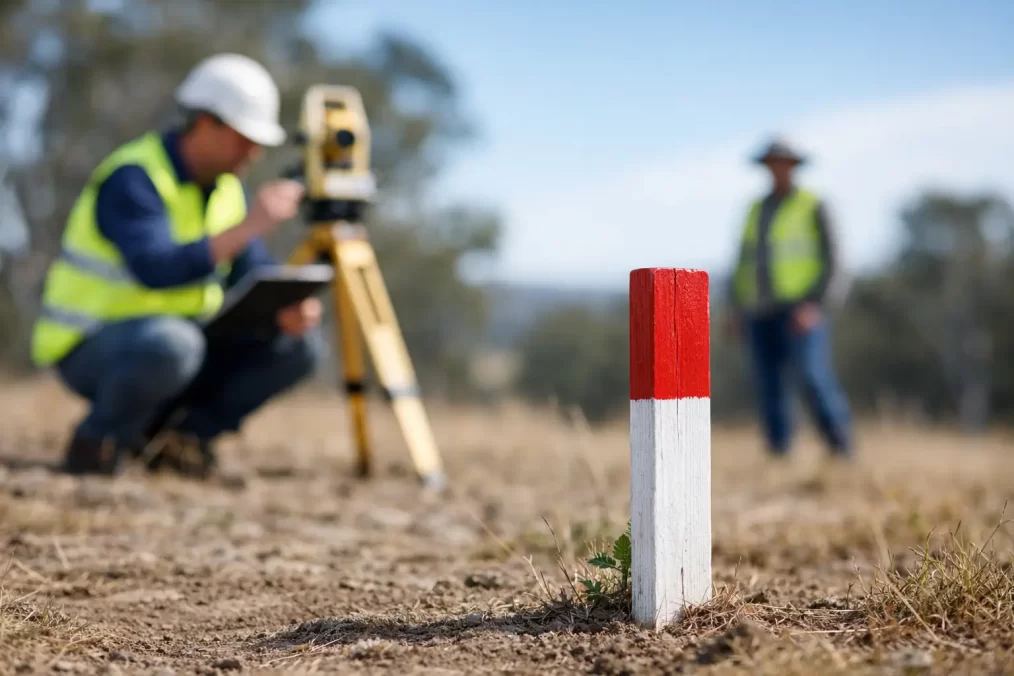
Who Can Place Boundary Pegs in NSW?
If you are planning a fence, extension, driveway or subdivision and wondering who can place boundary pegs, the short answer in NSW is this: boundary pegs that define a legal property boundary should be placed or reinstated by a registered land surveyor. That matters more than most owners realise, because a peg in the wrong spot can trigger neighbour disputes, council issues, redesign costs and avoidable delays.
Boundary pegs are not just handy markers in the ground. In the right context, they represent a surveyed opinion about where a title boundary sits in relation to occupation, existing marks, deposited plans and surrounding evidence. That is a legal and technical exercise, not a rough measuring job.
Who can place boundary pegs legally?
In practical terms, if the pegs are being used to mark the legal extent of land ownership, the work should be done by a registered surveyor. In NSW, registered surveyors are qualified, assessed for competency and authorised to carry out cadastral surveying work, which includes defining and marking property boundaries.
This is the key distinction many people miss. A builder, fencer, landscaper or handyman might be able to set out a line based on plans or measurements given to them, but that does not make them qualified to determine the legal boundary itself. If they guess wrong, the consequences land with the property owner.
A registered surveyor works from title information, survey plans, field evidence and statutory requirements. They do not simply measure from a fence corner and knock in a peg. They assess whether existing occupation matches title, whether old survey marks can be found, and whether enough evidence exists to reinstate the boundary with confidence.
Why a registered surveyor is usually the right answer
A boundary is rarely as simple as it looks on site. Fences can be offset, old pegs can be disturbed, retaining walls can mislead, and dimensions on old plans may need interpretation alongside surrounding survey evidence. On older properties across the Central Coast, that situation is common.
That is why a proper boundary mark-out is a professional service, not a quick favour. Registered surveyors are trained to resolve inconsistencies and apply the rules that govern cadastral boundaries. They also use surveying equipment designed for accuracy, which is critical when small errors can become expensive once construction starts.
If you are building close to a side boundary, replacing a fence, purchasing a property with unclear occupation, or preparing for subdivision, relying on assumptions is a risk. A formal survey gives you something far more useful than a stake in the ground – it gives you confidence that the mark reflects the legal boundary position as determined by a qualified professional.
When do boundary pegs need to be placed?
Not every project needs new pegs, but many benefit from a boundary mark-out before work begins. This is especially true where construction is tight to setbacks, where improvements are near a title line, or where neighbours disagree about where the boundary sits.
Common situations include fence replacement, new dwellings, garages, pools, retaining walls, granny flats, driveways and subdivision works. Identification surveys for building certificates or property transactions can also reveal when existing occupation does not align neatly with title dimensions.
Sometimes pegs are already present but unreliable. They may have been moved during earthworks, destroyed during construction or placed for temporary building set-out rather than cadastral purposes. A peg only has value if its origin and purpose are known.
Can a builder or fencer place boundary pegs?
A builder or fencer can place construction markers or align work to positions provided by a surveyor, but they should not be the person deciding where the legal boundary is. That is the crucial difference.
For example, a fencer may remove an old fence and install a new one along a line marked by a surveyor. A builder may set profiles for a slab once the boundary has been confirmed. Those trades are carrying out construction work. They are not performing a cadastral survey.
This matters because informal boundary marking often starts with good intentions. Someone measures from a plan, checks a tape against a side fence and assumes the result is close enough. But title boundaries are not established by convenience. If the measurement base is wrong, every decision that follows can also be wrong.
What happens during a boundary peg survey?
A proper boundary survey begins well before anyone arrives on site with equipment. The surveyor reviews title documents, deposited plans, easements, adjoining information and any prior survey data relevant to the parcel. They then inspect the site and surrounding evidence, looking for existing survey marks and occupation features.
From there, measurements are taken using professional survey equipment to connect the site into the broader survey framework and reconcile what is on the ground with the legal record. If sufficient evidence supports the boundary position, the surveyor can mark or reinstate corners and lines accordingly.
In some cases, the outcome is straightforward. In others, there may be missing marks, conflicting occupation or old survey anomalies that require more investigation. That is another reason the answer to who can place boundary pegs is not just about who owns a measuring tape. It is about who is qualified to evaluate evidence and stand behind the result.
Do boundary pegs guarantee there will be no dispute?
They reduce risk significantly, but context still matters. A professionally placed boundary peg is far stronger evidence than an assumed fence line, but disputes can still arise if neighbours have encroached, if occupation differs from title, or if someone later removes or ignores the marks.
This is why timing matters. It is far better to clarify the boundary before building or fencing than after concrete is poured or a dispute is already underway. Early surveying usually costs less than fixing the consequences of getting it wrong.
For owners, builders and designers, that early clarity also helps with approvals and set-out. You can proceed knowing the baseline information is reliable. That protects programme, budget and relationships with adjoining owners.
Who can place boundary pegs for subdivisions and development?
For subdivision and development work, boundary marking should be handled by a registered land surveyor with cadastral experience. These projects typically involve more than a simple corner mark-out. They can include easements, new title boundaries, plan preparation, coordination with consultants, authority requirements and registration processes.
Where development is involved, accuracy is not just about avoiding a neighbour issue. It affects design, engineering, services, compliance and the eventual registration of plans. An error at the boundary stage can ripple through the whole project.
That is why developers, architects and project managers generally want a surveyor who can support the job from initial survey through to final plan lodgement. A local consultancy with registered capability and fast turnaround can remove a lot of friction from that process.
How to choose the right surveyor
If you need boundary pegs placed, ask whether the person carrying out the work is a registered surveyor in NSW and whether the service includes a cadastral boundary mark-out rather than general set-out. Those are not the same thing.
It also helps to choose a surveyor familiar with local conditions, older subdivisions and the approval environment in your area. On the Central Coast, site history, terrain and development patterns can all affect how quickly a boundary can be resolved. Experience in local residential and development work tends to make the process faster and more practical.
Clear communication matters too. You want to know what is being marked, what evidence was relied on, whether there are any uncertainties, and how the survey fits into the next stage of your project. Good surveying advice should make decisions easier, not more confusing.
Central Coast Surveyors regularly works with homeowners, builders, architects and developers who need dependable boundary mark-outs and broader cadastral support across the region. The benefit is not just technical compliance. It is getting accurate information early enough to keep the project moving.
The real cost of getting it wrong
People often ask about survey costs when they should be asking about risk. A misplaced fence, non-compliant setback, encroaching slab or neighbour dispute can cost far more than a proper boundary survey. Even when the physical error is small, the delay and rework can be significant.
So if you are still asking who can place boundary pegs, the safest answer is the one that protects your title, your build and your timeline – engage a registered land surveyor and get the boundary marked properly before work starts.