Boundary Survey for Retaining Wall Work
Retaining wall projects often look simple at first – until the wall sits hard against a side boundary, changes drainage, or triggers a disagreement with the neighbour halfway through construction. That is where a boundary survey for retaining wall work becomes more than a box to tick. It gives you reliable, survey-based evidence of where the legal boundary sits before design, approvals and construction start moving.
For homeowners, that can mean avoiding an expensive mistake. For builders, engineers and designers, it means working from accurate cadastral information rather than assumptions, old fencing or rough measurements taken from online mapping. When a retaining wall is close to a boundary, even a small error can affect footing location, wall alignment, access, easements and responsibility for ongoing maintenance.
Why retaining walls create boundary issues so often.
A retaining wall changes levels, carries load and can alter the way water moves across a site. Unlike a simple garden edge, it usually has structural implications and often sits in the part of the block where space is tight. On many Central Coast sites, especially sloping land, there is not much room to move the wall if the original set-out is wrong.
The biggest problem is that people frequently rely on visible occupation lines. Existing fences, old walls and landscaped edges are not always on the legal boundary. Some are offset. Some were built from guesswork years ago. Some pre-date current plans or were placed to suit terrain rather than title dimensions. If a retaining wall is then designed off that physical line instead of the surveyed title boundary, the project can drift into encroachment territory very quickly.
That risk increases where the retaining wall also supports fill for a driveway, pool area, extension or new dwelling platform. In those cases, a boundary mistake is not just a fencing issue. It can affect engineering design, compliance, neighbour relations and future property transactions.
What a boundary survey for retaining wall projects actually does
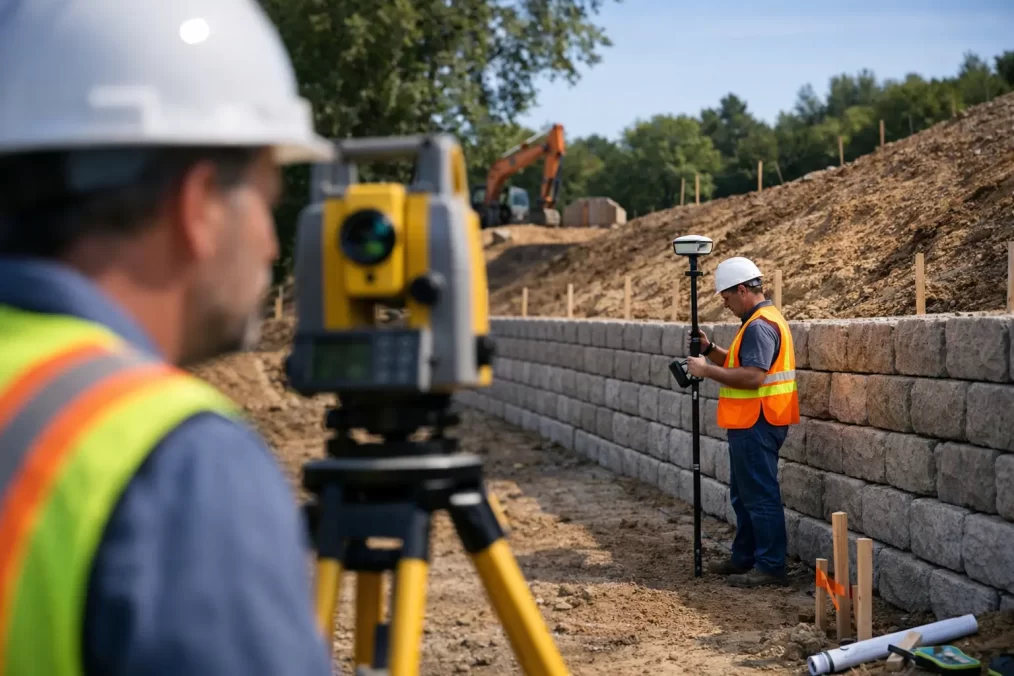
A boundary survey for retaining wall projects is used to identify and mark the legal title boundary on the ground. A registered surveyor reviews the deposited plan, title information and survey evidence, then undertakes field work to locate existing boundary marks and determine the correct boundary position.
This is different from estimating where the boundary should be. A proper cadastral boundary survey involves legal and technical responsibility. In New South Wales, boundary definition is regulated work and should be carried out by a registered land surveyor.
Once the boundary is established, the survey data can be used by the rest of the project team. The designer can position the wall with confidence. The engineer can design based on actual setbacks and site constraints. The builder can set out the work accurately. If council approval or certification is required, the project has a much stronger compliance foundation from the outset.
When you should arrange the survey
The best time is early – before final design and well before excavation starts. If the wall is proposed anywhere near a side or rear boundary, waiting until construction is underway usually creates unnecessary cost and pressure.
In practical terms, a survey is worth arranging when the retaining wall sits close to a title line, replaces an older wall of uncertain position, supports a building platform, or forms part of broader site works tied to approval conditions. It is also sensible where neighbour concerns already exist, because independent survey evidence helps keep discussions factual.
There are also cases where the wall itself may be entirely on one property, but excavation, footing width, drainage lines or construction access affect the adjoining land. A boundary survey helps identify those risks early, when the design can still be adjusted without major rework.
Why fences and online maps are not enough
This is one of the most common issues on residential jobs. A client assumes the fence marks the boundary, the designer draws the wall along the fence line, and the builder prices the works on that basis. Then the survey shows the fence is out by 150 millimetres, 300 millimetres or more. On a narrow site, that is enough to change the whole design.
Online mapping and satellite imagery are even less reliable for construction decisions. They are useful for broad context, but not for legal boundary definition or accurate set-out. Image position, scale and overlay accuracy can all vary. They should never be used as the basis for placing a retaining wall near a title boundary.
Survey control, title interpretation and physical boundary evidence are what count. That is what a registered surveyor brings to the project.
How the survey supports design, approvals and construction
A retaining wall rarely sits in isolation. It often connects to drainage design, stormwater disposal, cut and fill calculations, driveway grades, landscape works and neighbour interface. Accurate boundary information helps every consultant work from the same base data.
For architects, planners and engineers, this reduces redesign risk. If the boundary is wrong at concept stage, errors can flow through the entire documentation set. For builders and project managers, it improves sequencing and lowers the chance of disputes once machinery is on site. For property owners, it gives clarity before committing to construction costs.
In some projects, the boundary survey is paired with a detail and contour survey. That combination is especially useful on sloping sites, because it allows the retaining wall to be designed with both the legal boundary and the actual site levels in mind. You get a clearer picture of where the wall can go, how high it needs to be and what constraints need to be managed.
Boundary survey for retaining wall approval issues
Whether council approval is required depends on the wall height, location, associated works and local planning controls. Some retaining walls may fall within exempt development parameters, while others need approval or supporting documentation. The exact pathway depends on the project.
What does not really change is the value of accurate survey information. If the wall is near a boundary, survey data helps show the true relationship between the proposed structure and the title line. That can be critical where setbacks, drainage, structural certification or neighbour impacts are under review.
It also helps avoid the awkward situation where approval drawings show a compliant wall position, but the built outcome shifts because the actual boundary was never properly marked. Fixing that after the fact is far harder than getting it right up front.
What happens if you skip it
Sometimes nothing dramatic happens. The wall is built, no one asks questions, and the project moves on. But that is not a reliable risk strategy – especially when land levels, structures and property rights are involved.
When things do go wrong, the consequences can be expensive. The wall may encroach across the boundary. Footings may extend into the adjoining lot. Drainage may discharge in the wrong direction. A neighbour may object once they realise the wall affects their land or future fencing. In more serious cases, you may be looking at redesign, demolition, legal advice or delayed certification.
Even if the wall remains inside the lot, a poor understanding of the boundary can still lead to over-engineering or under-utilisation of available space. Both outcomes cost money. Survey accuracy gives the design team room to make informed decisions rather than conservative guesses.
Choosing the right survey input for your project
Not every retaining wall needs the same level of survey work. A simple low wall well inside the property may only need limited input. A structural wall near a boundary on a sloping site usually calls for a more complete approach, often combining boundary definition with topographical information and later construction set-out.
That is why early advice matters. A surveyor can assess the title, site conditions and intended works, then recommend the survey scope that fits the job. This avoids paying for unnecessary work, but it also helps prevent the far more expensive mistake of under-scoping the survey at the start.
For clients across the Central Coast, local knowledge also counts. Terrain, older subdivisions, missing marks and site access can all affect the way a boundary survey is carried out and how quickly useful results can be delivered. Central Coast Surveyors works with homeowners and project teams to provide clear boundary information that can be used straight away by designers, engineers and builders.
The practical value is certainty
A retaining wall near a boundary is not the place for assumptions. The cost of a survey is small compared with the cost of getting the wall position wrong, delaying approvals or arguing over encroachment after construction.
The real value of a boundary survey for retaining wall work is certainty. It gives everyone involved – owner, designer, engineer, builder and neighbour – a clear starting point based on measured evidence, not guesswork. If your wall is close to a boundary, that clarity is usually the difference between a straightforward project and a problem that grows legs. Get the boundary right first, and the rest of the job tends to move far more cleanly.