
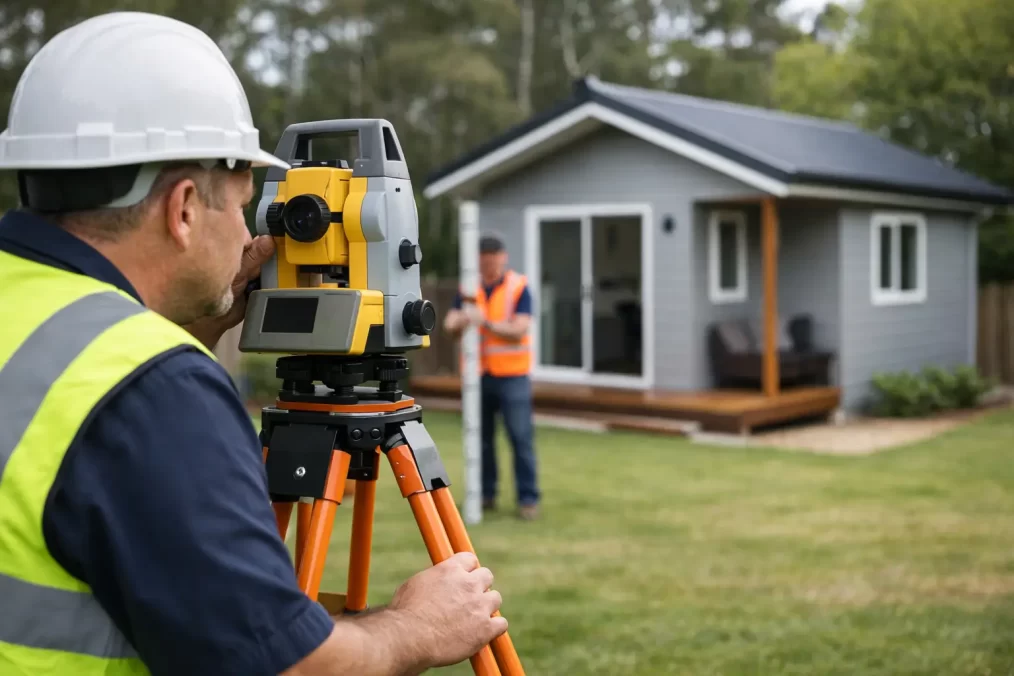
Surveyor for Granny Flat Approvals
A granny flat can look straightforward on paper until the approval process starts asking harder questions. Is the boundary clear? Do the contours work for drainage and slab design? Are there easements, setbacks or level differences that affect where the building can actually go? That is where a surveyor for granny flat approvals becomes essential, not as an extra step, but as the foundation for getting the design, approval and construction stages moving properly.
On the Central Coast, granny flat projects often sit on sites with more complexity than owners first expect. Sloping blocks, older fences that do not match title boundaries, stormwater constraints, waterfront conditions and existing structures can all affect what is possible. Accurate surveying gives your architect, designer, planner and builder reliable information from the start, which helps avoid redesigns, approval delays and construction surprises.
Why a surveyor matters before plans are lodged
A granny flat approval relies on more than a floor plan and a site sketch. Whether the project is going through a complying development pathway or a development application, the assessment depends on real site conditions. Councils, certifiers and design consultants need to know what is actually on the land, not what appears to be there from old drawings or online mapping.
A registered surveyor provides that certainty. Through a detail and contour survey, they map the existing features of the site, including buildings, fences, retaining walls, trees, services visible at the surface, levels and fall across the land. They also identify title boundaries and relevant site constraints that may affect where a granny flat can be positioned.
This matters because small errors early on can create much larger problems later. If a design is prepared from incomplete or inaccurate site information, setbacks may be wrong, finished floor levels may need revision, stormwater design may change, or excavation costs may increase. In some cases, a structure may even be positioned in a way that creates non-compliance.
What a surveyor for granny flat approvals typically provides
The most common starting point is a detail and contour survey. This gives the design team the base information needed to prepare plans that reflect the actual landform and existing improvements. For granny flats, that is often the key survey product because site levels, drainage and available building area directly affect feasibility.
If boundary position is uncertain, a cadastral boundary survey or boundary mark-out may also be required. This becomes especially important on older residential lots where fences have shifted over time, rear yard structures have been added without clear offsets, or neighbouring improvements sit close to the common boundary. Relying on a fence line without checking title can be a costly mistake.
In some projects, additional survey information is needed. A floor level report may support design or flood-related requirements. An identification survey may help confirm the relationship between improvements and title boundaries where compliance or certification issues arise. If the broader development involves subdivision or title changes later, surveying will continue to play a role beyond the approval stage.
When to engage a surveyor for granny flat approvals
The best time is at the feasibility stage, before design work gets too far. Owners sometimes wait until plans are already underway, thinking they can save time or cost by using approximate dimensions first. In practice, that approach often creates delays because designers end up revising plans once accurate site data arrives.
Early surveying helps answer the practical questions quickly. Is there enough usable area for the granny flat and required access? Is the block steeper than expected? Will retaining walls or cut and fill be needed? Are there site features that limit the building envelope? These answers shape design decisions, consultant input and project budget.
For builders, planners and architects, a prompt survey also protects programme. Approval pathways are rarely slowed by having too much accurate information. They are regularly slowed by missing information, inconsistent documentation or redesign caused by incorrect assumptions.
Common issues that hold granny flat approvals up
Boundary uncertainty is one of the biggest problems. A homeowner may assume the side fence marks the legal boundary, only to find the fence is out of position. That can affect setbacks, access widths and the available footprint for the proposed building.
Levels are another common issue. A granny flat on a sloping block may require more retaining, drainage design or level adjustment than expected. Without a proper contour survey, those costs can surface late, after the design has been priced or lodged.
Easements also need careful attention. Sewer, drainage or access easements can restrict where a structure can go. If those constraints are missed early, the design may need substantial revision. The same applies to existing structures such as sheds, awnings, decks and retaining walls that reduce the practical building area.
Then there is coordination. Granny flat approvals often involve several consultants, including the designer, planner, certifier, engineer and builder. If each party is working from different assumptions about the site, delays are almost guaranteed. Accurate survey information gives everyone the same starting point.
What to look for in a surveyor
Not every survey provider offers the same level of project support. For granny flat approvals, you want a registered surveyor with strong local knowledge, fast turnaround and experience working with residential approvals and construction consultants.
Registration matters because it reflects formal qualifications, board competency and accountability. For boundary and cadastral work especially, that level of professional responsibility is critical. Local knowledge matters because approval and construction issues vary from one area to another. A surveyor familiar with Central Coast sites will better understand the practical conditions that often affect residential projects, from site fall and drainage to older subdivisions and boundary evidence.
Responsiveness also matters more than many clients expect. A survey is rarely produced in isolation. Designers may need clarification, planners may need specific details, and builders may want mark-out information later. A surveyor who communicates clearly and works well with the rest of the project team can save real time across the whole job.
How surveying supports both approval and construction
The value of good surveying does not stop once approval is issued. The same survey data that supports the initial design can continue through construction set-out, final works and compliance stages. That continuity reduces rework because the project is not being handed between unrelated providers with different data sets or site interpretations.
For example, once the granny flat is approved, construction set-out ensures the building is positioned correctly on site in line with the approved plans. If the slab or structure is set out poorly, even a compliant design can become a compliance issue on the ground. Accurate set-out helps protect the build from those risks.
That end-to-end approach is particularly useful for clients who want one reliable consultant involved from the first survey through to final documentation. It keeps information consistent and makes communication easier across the life of the project.
Surveyor for granny flat approvals on the Central Coast
On the Central Coast, site conditions can change quickly from one suburb to the next. Flat suburban lots, waterfront land, battle-axe access, older residential areas and semi-rural holdings all bring different surveying and approval considerations. A surveyor for granny flat approvals needs to do more than collect measurements. They need to provide usable, accurate information that helps the rest of the team make sound decisions quickly.
That is why practical delivery matters. Fast fieldwork, precise data capture, clear plans and straightforward communication all help keep the project moving. For homeowners, that means less confusion and fewer approval surprises. For builders, architects and planners, it means better documentation and fewer avoidable hold-ups.
Central Coast Surveyors works across that full process, from initial detail and contour surveys through boundary work, construction set-out and final registration-related services where required. For granny flat projects, that kind of coordinated support can make the path from concept to construction much more manageable.
The real cost of getting the survey wrong
Most clients are not worried about surveying itself. They are worried about delays, redesign costs and approval setbacks. That is exactly why the right survey input matters. The cost of accurate surveying is usually small compared with the cost of moving a building footprint, revising engineering, pausing a certifier review or dealing with a boundary issue after work has started.
There is also a risk management angle. A granny flat is a real asset on your property. Whether it is being built for family, rental income or long-term flexibility, it needs to be positioned and documented correctly. Accuracy at the start protects value at the end.
If you are planning a granny flat, treat the survey as one of the first practical decisions, not a formality to sort out later. Clear site information gives the whole project a better footing, and that usually means fewer headaches once the real work begins.