
Construction Set Out Survey Explained
A wall that sits 150mm off line can turn into a very expensive problem once the slab is poured. That is why a construction set out survey matters so early in the build. It gives builders, owners and consultants clear physical reference points on site so the approved design is placed in the correct position, at the correct level, and in the correct alignment.
For residential projects, commercial works and civil construction alike, set-out is the step that converts plans into marks on the ground. Done properly, it helps keep a project moving. Done poorly, it can lead to delays, disputes, non-compliance and rework that costs far more than the survey itself.
What a construction set out survey does
A construction set out survey transfers the approved design from drawings and digital plans onto the land. In practical terms, that means a surveyor identifies where a building, driveway, retaining wall, services, roads or other works should be built in relation to title boundaries, existing features and nominated levels.
The output is not just a few pegs in the ground. It is a controlled process based on survey control, plan interpretation, site conditions and precision equipment. Depending on the project, the surveyor may mark grid lines, offsets, building corners, wall alignments, column positions, kerb lines, service runs or floor levels.
This is where registration, experience and local knowledge matter. On many sites, the plans look straightforward until they meet sloping land, tight clearances, older title information or conflicting assumptions between consultants. A reliable set-out survey picks up those issues before they become site problems.
Why set-out errors cost more than most people expect
Most construction mistakes are cheaper to fix on paper than on site. Once excavation starts, formwork is installed or concrete is poured, even a small position error can affect setbacks, structural layout, drainage, easements or neighbouring property clearances.
For homeowners, that might mean a shed or house extension ending up too close to a boundary. For builders, it can mean lost time waiting for clarification, arguing over who carries responsibility, or redoing work already completed. For developers and project managers, the cost is often broader – trades delayed, programme pressure increased, and approval risks compounded.
There is also a compliance issue. A build placed outside approved setbacks or levels may require redesign, amended approvals or rectification work. On constrained sites across the Central Coast, where topography, access and adjoining development can all influence construction, accuracy at set-out stage is not optional.
When a construction set out survey is usually needed
The timing depends on the type of project and how it is being delivered. In most cases, set-out takes place after design is sufficiently resolved and before the relevant construction element begins.
For a new dwelling, that often means setting out the building footprint before excavation or slab preparation. For multi-stage work, separate set-outs may be required for bulk earthworks, retaining walls, footings, services, structural gridlines and final external works. Civil and subdivision projects often involve repeated set-out across different stages as roads, drainage and infrastructure are installed.
It is not always one survey at one point in time. Some projects need progressive set-out as construction advances, especially where tolerances are tight or multiple consultants are relying on the same control.
What information the surveyor needs
Good set-out starts with good inputs. If the plans are incomplete, superseded or inconsistent, the risk moves straight onto site. Before attending, the surveyor typically needs the latest approved architectural, structural or civil drawings, together with any relevant engineering details and level information.
Boundary definition also needs to be clear. In some cases, an earlier detail and contour survey or cadastral survey forms the basis for the set-out. On other sites, especially where boundary marks are unclear or older occupation does not match title dimensions, additional investigation may be required before construction points can be safely placed.
This is one of the reasons an end-to-end surveying service is useful. When the same consultancy understands the site from initial survey through to construction and final survey, there is usually less duplication, fewer assumptions and faster issue resolution.
How the set-out process works on site
The first step is establishing or confirming survey control. These are known reference points that allow all marked positions and levels to be related back accurately across the site. From there, the surveyor checks the plans, calculates the required positions and uses survey equipment to mark them physically.
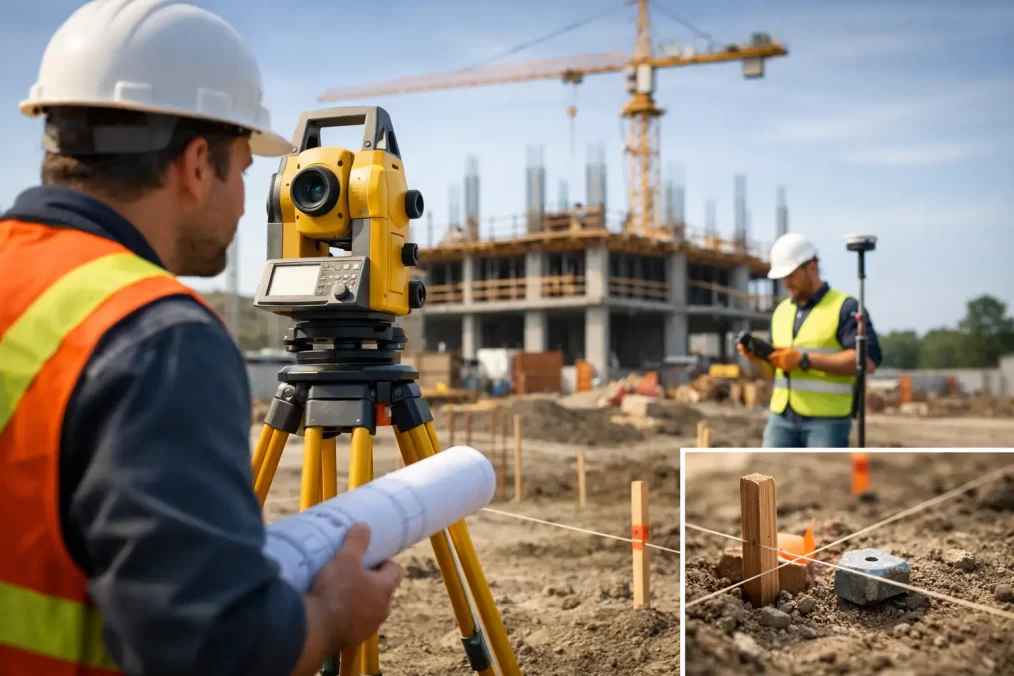
On a typical building site, the marks may include offset pegs, profile boards, nails, paint marks or labelled reference points placed so they remain usable once machinery starts moving through the area. Where needed, reduced levels are also provided for excavation depth, slab height or drainage work.
Modern Trimble equipment allows high precision and efficient transfer of design data to site, but technology on its own is not the service. The real value comes from accurate calculations, proper checking and practical judgement about how marks will be used by builders and trades in live construction conditions.
Set-out for houses, duplexes and small developments
In residential work, the construction set out survey often focuses on building footprint, setbacks to boundaries and finished floor levels. This is particularly important on narrow lots, battle-axe sites, sloping blocks and waterfront or semi-rural properties where constraints can stack up quickly.
A few centimetres can matter. If a building is pushed too far in one direction, it may affect eave clearance, drainage falls, driveway layout or compliance with council requirements. If floor levels are wrong, water management and access outcomes can be compromised before the frame is even up.
For duplexes, townhouse projects and small unit developments, the margin for error is usually tighter again. Multiple walls, fire separation requirements, parking layouts and service corridors all depend on the initial set-out being right.
Set-out for civil and commercial projects
Larger projects usually involve more stakeholders and more interfaces. Engineers, contractors, hydraulic designers, service authorities and certifiers may all be relying on the same reference framework. In these environments, survey clarity saves time.
Civil set-out can include kerb alignments, stormwater pits, sewer lines, pavement extents, retaining structures and finished surface levels. Commercial work may require structural grids, lift cores, columns and external works to be coordinated across a staged programme.
The main difference is not just scale. It is coordination. A surveyor who responds quickly, works cleanly with other consultants and flags inconsistencies early can help keep the whole job moving.
Why local knowledge helps on the Central Coast
No two sites present exactly the same conditions, but local experience does shorten the learning curve. Across the Central Coast, survey work often has to account for sloping terrain, bushfire-prone land, waterfront interfaces, older subdivisions, rural allotments and varied council requirements.
That context matters when interpreting plans, checking existing marks and anticipating practical site issues. It also helps when survey data needs to line up with the expectations of local designers, builders, certifiers and approval pathways.
For clients, the benefit is simple – fewer surprises and faster answers when timing is tight.
Choosing the right surveyor for set-out work
Price matters, but construction set-out is not a service where the cheapest option always saves money. Accuracy, turnaround time and communication are what protect the project.
A registered surveyor brings formal accountability and technical competence. That matters if questions arise later about boundary position, compliance or how the works were referenced. Equally important is responsiveness. Construction programmes move quickly, and a delayed survey can hold up excavation crews, concretors or framing teams.
It also helps to work with a consultancy that can support the broader project lifecycle, from detail and contour survey through set-out, final surveys and plan registration. That continuity reduces handover gaps and makes coordination easier for everyone involved.
Central Coast Surveyors works this way because most clients do not want to juggle multiple disconnected providers. They want clear advice, accurate fieldwork and a survey partner who can keep pace with the job.
A well-executed construction set out survey does more than place marks on the ground. It gives your project a reliable starting point, which is often the difference between steady progress and expensive correction later on. If the build needs to be in the right place the first time, getting the survey right is one of the smartest early decisions you can make.