
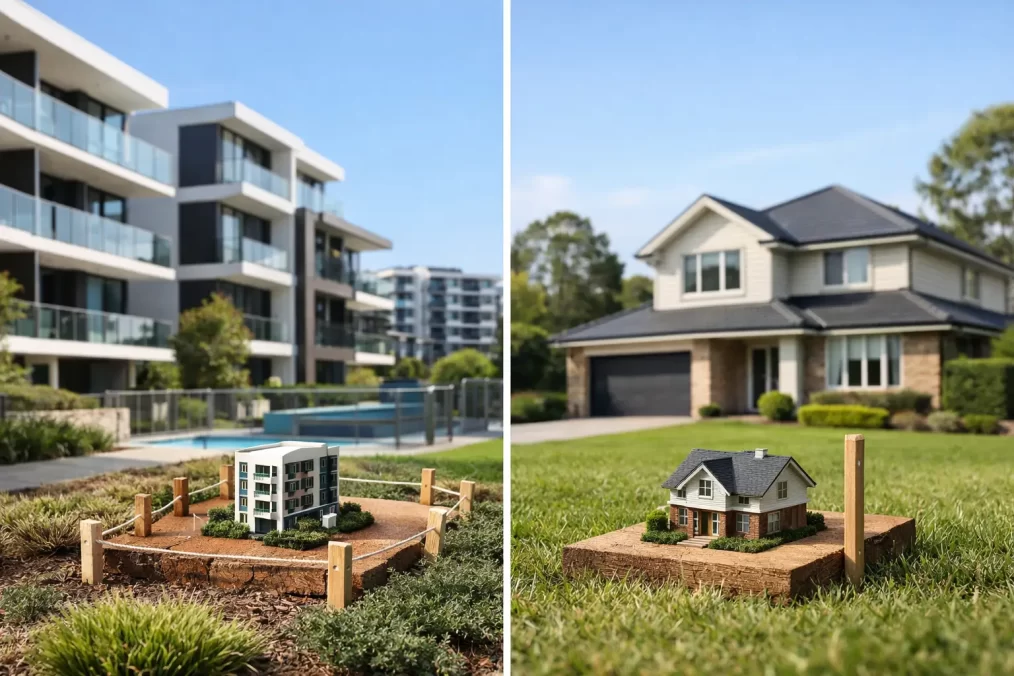
Strata Title vs Torrens Title Explained
Buying, building on or subdividing property in NSW often comes down to one question sooner than people expect – strata title vs torrens title. It affects what you own, what you share, how approvals work, and what your project will cost in time and coordination. If you’re planning a duplex, townhouse project, unit development or small subdivision on the Central Coast, getting this clear early can save a lot of rework later.
For many owners, the confusion starts because both title types can apply to residential property, but they work very differently. One gives you ownership of an individual lot and building with minimal shared property. The other usually involves private ownership of part of a building or lot together with shared responsibility for common areas. That difference flows through design, surveying, legal setup, services, access and ongoing management.
What is the difference between strata title and Torrens title?
A Torrens title is the most straightforward form of land ownership in NSW. You own the land within your lot boundaries and, in most cases, the building on it. There is no owners corporation managing shared common property because the lot is generally independent.
A strata title is different. You own a lot, which is commonly an apartment, townhouse, villa or part of a building, and you also share ownership of common property with other lot owners. Common property can include driveways, foyers, roofs, gardens, stairwells, external walls and service areas, depending on the plan.
From a practical point of view, Torrens title usually suits projects where each dwelling can sit on its own clearly defined parcel of land. Strata title is often used where dwellings share built form, access or services, or where the layout makes separate freehold lots less practical.
Why the title type matters before design is finalised
Title structure is not just a legal detail handled at the end. It influences the way a development is designed from the start. If you are an owner building a duplex, or an architect preparing concept plans, the intended title can affect setbacks, access arrangements, service connections, private open space, stormwater design and how boundaries are defined.
This is where early surveying input matters. A registered surveyor can assess the site, existing boundaries, easements, constraints and proposed layout so the project team is working towards a title outcome that is actually achievable. Leaving that discussion too late can create delays with redesign, approval conditions or registration.
Strata title vs torrens title for duplexes and multi-dwelling projects
On the Central Coast, one of the most common questions is whether a duplex can be Torrens titled or whether it needs to be strata titled. The answer depends on the site, the planning controls and the physical design.
If each dwelling can meet the requirements for its own lot, including frontage, access, setbacks and servicing, a Torrens subdivision may be possible. That can be attractive to buyers because each residence is held on its own title without shared common property or an owners corporation.
If the design includes shared driveways, structural overlap, service infrastructure that cannot be cleanly separated, or site constraints that prevent a conventional lot layout, strata may be the more workable option. In some cases, strata is also faster or more efficient because it aligns better with the built form.
There is no one-size-fits-all answer. The right structure depends on planning controls, engineering realities and the commercial goals of the project.
Ownership, control and ongoing obligations
For many property owners, the biggest practical difference between strata title and Torrens title is what happens after settlement or registration.
With Torrens title, responsibility usually sits with the individual owner. You maintain your own building and land, subject to any easements, restrictions on use or planning controls affecting the lot. Decision-making is relatively simple because there is no shared management structure.
With strata title, owners share responsibility for common property through an owners corporation. That means levies, meetings, by-laws and collective decisions about maintenance and repairs. For some developments, that structure is entirely reasonable because the shared areas need coordinated management. For others, especially where buyers are looking for a house-like product, it may be seen as a drawback.
Neither option is automatically better. Torrens title offers more independence, but it may not suit every site or design. Strata title can provide a practical framework for more complex developments, but it comes with shared obligations that owners need to understand.
Surveying and registration differences
From a surveying perspective, the pathway to registration is different for each title type.
A Torrens title subdivision generally involves creating separate lots defined by surveyed land boundaries. The subdivision plan must reflect dimensions, lot layout, easements and any other matters required for registration. Survey accuracy and compliance are critical because the resulting title boundaries become the legal framework for ownership.
A strata subdivision works differently because boundaries can be defined by the building itself, not just the land. The registered strata plan identifies lots and common property, and those boundaries may relate to walls, floors and ceilings depending on the type of strata scheme. That requires careful measurement, drafting and coordination with architectural and construction information.
If the project is under construction, timing also matters. Final surveys, finished building dimensions and service layouts all need to align with what is lodged for registration. This is why experienced survey coordination helps reduce last-minute issues.
Cost considerations beyond the title itself
Clients often ask which option is cheaper. The honest answer is that it depends on the site and the development model.
A Torrens title outcome can add value and improve market appeal, particularly where buyers want standalone ownership. But achieving that outcome may require larger lot sizes, duplicated services, separate access arrangements or a different building layout. Those design and infrastructure requirements can increase upfront project costs.
A strata title scheme may allow a more efficient use of land and built form. It can work well where access and infrastructure are shared, or where the building configuration naturally suits strata boundaries. However, strata also introduces scheme setup requirements and ongoing management obligations that affect owners after completion.
The right question is not just which title costs less to create. It is which title makes the project feasible, compliant and commercially sensible.
Common situations where each title may suit best
Torrens title often suits detached homes, dual occupancies where lots can be clearly separated, and some duplex projects where planning controls support independent lots. It is usually preferred when the goal is straightforward ownership with minimal shared infrastructure.
Strata title often suits apartment buildings, mixed-use developments, villa complexes, townhouse rows with shared areas, and duplexes on constrained sites. It is also common where there are shared driveways, common services or building elements that make separate freehold lots impractical.
That said, similar-looking developments can end up with different title structures. Two duplex sites in the same suburb may not have the same answer because frontage, slope, access, easements and servicing can change the available pathway.
Getting the right advice early
The most efficient projects are the ones where the surveyor, designer and planning team are aligned before detailed documentation is locked in. If you’re weighing up strata title vs torrens title, that discussion should happen at feasibility stage, not when the build is nearly complete.
Early advice can help answer practical questions such as whether the existing parcel can be subdivided as proposed, whether new easements are needed, how boundaries should be configured, and what information will be required for final registration. It also helps reduce the risk of designing something that works on paper but becomes difficult to title later.
For owners and developers across the Central Coast, this is often where local knowledge makes a real difference. Council expectations, servicing constraints, waterfront issues, access arrangements and subdivision patterns vary from site to site. A registered surveyor who regularly works through the full process – from detail survey to final plan registration – can help keep the project moving and avoid preventable delays.
Which title is better?
Usually, the better title is the one that fits the site, the planning framework and the end goal of the project.
If you want independent ownership, clear lot boundaries and no shared management structure, Torrens title is often the preferred outcome. If the development relies on shared property or the site does not support clean lot separation, strata title may be the more practical and compliant solution.
The key is not to treat the title decision as an afterthought. It should be tested early, mapped accurately and coordinated with the rest of the approval and construction process. That is where a clear surveying strategy can save both time and cost.
If you’re planning a subdivision, duplex or multi-dwelling project and need clarity on the most suitable title pathway, getting site-specific advice upfront will put the whole job on firmer ground.